
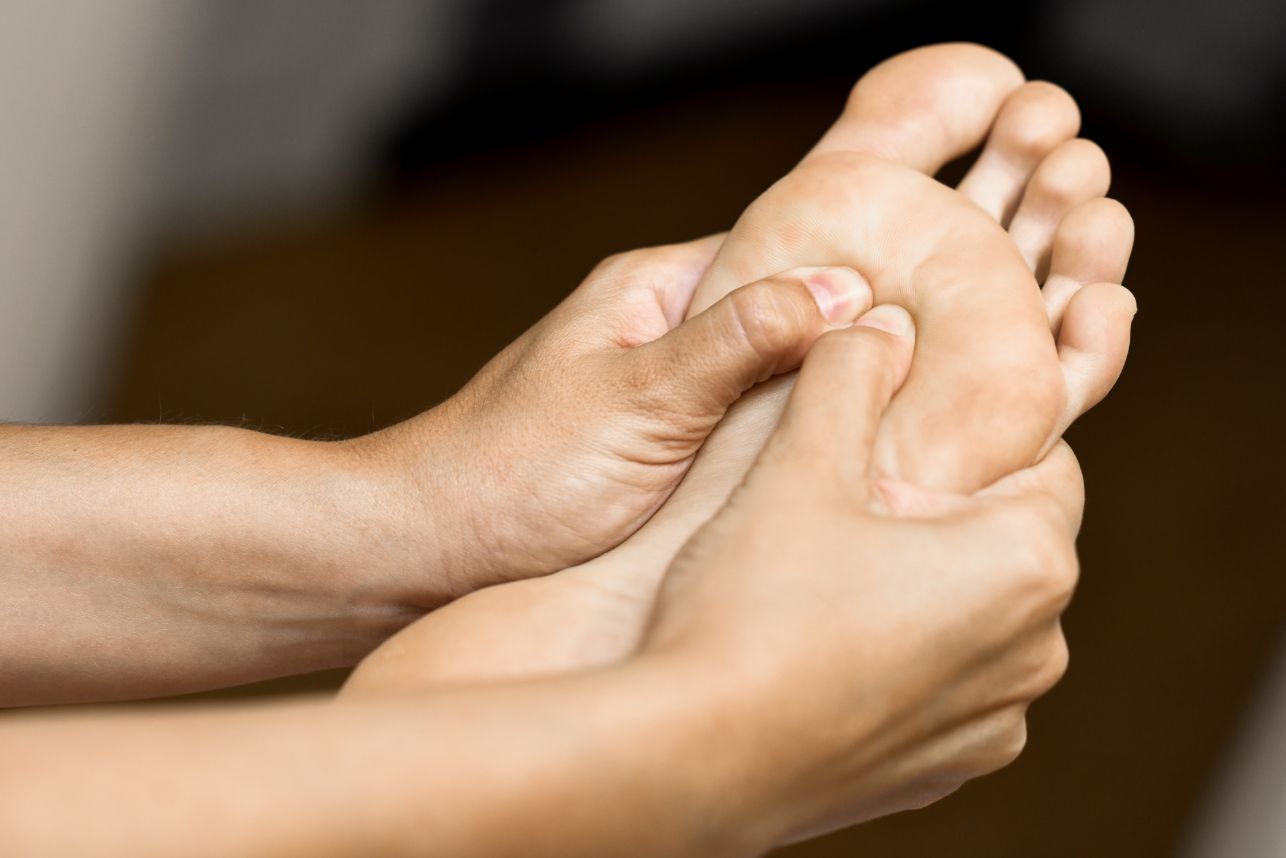
You swing your legs out of bed, put your foot on the floor — and a sharp, stabbing pain shoots through your heel, as if you've stepped on a stone or a nail. You hobble for the first minute or two, it eases as you move around, and you think it's gone. Then after standing at the kitchen counter, or a long day on your feet, it's back. If that's your morning, there's a very good chance you have plantar fasciitis — the most common cause of heel pain there is.
This is a long, honest guide, because heel pain deserves more than "rest it and take a painkiller." By the end you'll understand exactly why your heel hurts, which treatments genuinely work (and which are oversold), and one question I get asked constantly: is PRP actually better than a steroid injection? We'll answer that with the evidence, not hype. Written and reviewed by an interventional pain specialist.
Plantar fasciitis is irritation and gradual wear of the plantar fascia, the strong band along the sole that supports your arch. It causes sharp first-step heel pain in the morning or after rest. The great majority of people — around 80–90% — get better within 6–12 months with stretching, supportive footwear and activity changes. For stubborn (chronic) cases, shockwave therapy and ultrasound-guided PRP are evidence-supported options. Steroid injections give faster short-term relief, but PRP tends to last longer in chronic cases. Surgery is rarely needed. The key is accurate diagnosis and matching the treatment to the patient.
Quick navigation
- What it is • anatomy • causes • symptoms
- The heel-spur myth • what it's confused with • diagnosis & ultrasound
- Can it heal on its own? • conservative treatment • shockwave (ESWT)
- Should you get a steroid injection? • PRP in depth • PRP vs steroid
- Why ultrasound guidance matters • surgery • home exercises • 35 FAQs
What Is Plantar Fasciitis? (And Why the Name Can Mislead)
The plantar fascia is a tough, fibrous band that runs along the bottom of your foot, from your heel bone to the base of your toes. It works like a bowstring that supports the arch and springs you forward with every step.
The name "plantar fascia-itis" suggests inflammation ("itis" means inflammation). And in the early days, that's partly true. But here's a crucial detail most websites skip: when doctors have looked at chronic, long-standing cases under the microscope, they mostly find degeneration — disorganised, worn collagen fibres — rather than active inflammation. That's why the more accurate name for chronic cases is plantar fasciosis ("osis" means degeneration, not inflammation).
Why does this matter to you? Because it changes what treatment makes sense. If a stubborn heel problem is mostly wear and degeneration, then a treatment that only fights inflammation — like a steroid injection — may calm the pain for a while but doesn't rebuild the tissue. This single insight is the key to the whole steroid-versus-PRP question we'll get to later.
The Anatomy, Made Simple
You only need to picture five things:
- The plantar fascia — the "bowstring" along your sole that holds up the arch.
- The heel bone (calcaneus) — where the fascia anchors, and exactly where it usually hurts (the inner side of the heel).
- The arch of the foot — the spring the fascia supports; both flat feet and very high arches change the strain on it.
- The calf muscles & Achilles tendon — tight calves pull on the heel and increase the load on the fascia. This is why calf stretching helps heel pain.
- The windlass mechanism — when you push off and your toes bend up, the fascia tightens and lifts the arch, like winding a rope around a drum. This is also why pulling your toes back stretches the fascia (and why that stretch works).
In plain terms: think of the plantar fascia as a strong elastic band under your foot. Overload it — too much, too soon, on tight calves and poor footwear — and it frays where it attaches to the heel. That fraying is what hurts.
[Illustration ideas: (1) a side view of the foot showing the plantar fascia as a bowstring from heel to toes, with the sore spot marked at the inner heel; (2) the windlass mechanism — toes dorsiflexed, fascia tightening, arch rising; (3) a simple "healthy vs degenerated fascia" close-up.]
What Causes Plantar Fasciitis?
Plantar fasciitis is almost always an overload problem — the fascia is asked to do more than it can handle. Common contributors:
- A sudden increase in activity — ramping up running, walking or standing too quickly (the classic "I started a new fitness plan" story).
- Jobs that keep you on your feet — teachers, nurses, factory and retail workers, cooks.
- Running and high-impact sport.
- Tight calf muscles and reduced ankle flexibility — one of the strongest, most fixable risk factors.
- Being overweight — more load through the heel with every step.
- Foot shape — both flat feet and high arches change how force passes through the fascia.
- Poor or worn-out footwear — flat, unsupportive shoes, or old trainers.
- Weak intrinsic foot muscles — the small muscles that support the arch.
- Age — most common between about 40 and 60.
Usually it's a combination — say, tight calves plus a spike in walking plus flat, worn shoes. The good news is that most of these are things we can change.
Symptoms: What Plantar Fasciitis Feels Like
Plantar fasciitis has a very recognisable pattern:
- First-step pain — sharp, stabbing heel pain on your first steps in the morning, or after sitting for a while.
- Pain that eases as you warm up, then returns after long standing or walking, or at the end of the day.
- Tenderness on the inner part of the heel, where the fascia attaches.
- Pain after (not usually during) exercise.
- Feeling like you're stepping on a pebble or a bruise.
It's usually one heel, though it can affect both. If both heels hurt, especially in a younger person or with other joint pains, we think harder about inflammatory causes (more on that below).
Acute vs Chronic Plantar Fasciitis
| Feature | Acute (early) | Chronic (plantar fasciosis) |
|---|---|---|
| Duration | Days to a few weeks | More than about 3–6 months |
| Underlying process | More inflammation and irritation | More degeneration and worn tissue |
| Fascia on ultrasound | Mildly thickened | Thickened, with degeneration or small tears |
| Usual best treatment | Stretching, footwear, load management | Add ESWT / PRP if conservative care fails |
| Response to steroid | Often good short-term | Short-lived; doesn't repair the tissue |
The Heel Spur Myth
Ask around and someone will tell you their heel pain is "a spur." Let's clear this up, because it changes how you think about treatment.
- Many people have heel spurs and no pain at all — spurs show up on X-rays of plenty of pain-free feet.
- Many people with plantar fasciitis have no spur.
- When a spur is present, it's generally a result of long-standing pulling forces, not the cause of the pain — and it usually sits in a nearby muscle's attachment, not in the painful part of the fascia.
Bottom line: we treat the plantar fascia, not the spur. Chasing or removing a spur is rarely the answer.
| Question | Plantar fasciitis | Heel spur (on its own) |
|---|---|---|
| What it is | Irritation/degeneration of the fascia | A small bony outgrowth on the heel |
| Causes pain? | Yes — the usual source of heel pain | Often not — frequently painless |
| Seen on X-ray | Not directly (fascia is soft tissue) | Yes |
| Treatment target | The fascia and its overload | Rarely treated on its own |
Is It Really Plantar Fasciitis? Conditions That Copy It
Most heel pain is plantar fasciitis — but not all of it. Getting the diagnosis right is the difference between weeks of the right treatment and months of the wrong one. The main mimics:
| Condition | How it differs from plantar fasciitis |
|---|---|
| Calcaneal stress fracture | Deep, aching heel pain that worsens with impact/activity; tender when the heel bone is squeezed from both sides; often in runners or after a training spike. |
| Fat pad syndrome / atrophy | Pain in the centre of the heel, more of a deep bruise; common in older adults and after repeated steroid injections; worse on hard floors. |
| Tarsal tunnel syndrome | Burning, tingling or numbness rather than sharp first-step pain; a nerve is pinched at the inner ankle; may have a positive tap sign (Tinel's). |
| Baxter's nerve entrapment | A trapped small nerve near the heel; burning pain, sometimes without the classic morning pattern; can coexist with plantar fasciitis. |
| Achilles / insertional problems | Pain at the back of the heel, not underneath. |
| S1 lumbar radiculopathy | Heel pain referred from a pinched nerve in the back; usually with back or leg symptoms. |
| Inflammatory arthritis | Both heels, morning stiffness elsewhere, other joints involved; think of spondyloarthritis, especially in younger patients. |
| Peripheral neuropathy | Numbness/burning in a stocking pattern in both feet, often with diabetes. |
This is exactly why a proper assessment matters — and why we sometimes use ultrasound or an X-ray to be sure.
How Plantar Fasciitis Is Diagnosed
In most cases the diagnosis is clinical — made from your story and a hands-on examination, with no scan needed. The typical first-step pain and tenderness at the inner heel are very telling, and we check your calf tightness, arch, and the other structures around the heel.
When imaging is not needed: a classic history and examination in someone improving with treatment usually needs no scan at all.
When imaging is helpful: if the picture is unusual, the pain is not settling, we suspect a mimic (stress fracture, nerve entrapment), or we're planning an injection. Then:
- Ultrasound — the workhorse. Painless, radiation-free, quick, and it shows the fascia directly. It also guides injections in real time.
- X-ray — mainly to look at the bone (a spur, or signs of a stress fracture); it can't show the fascia itself.
- MRI — reserved for unclear cases, suspected stress fracture, or before surgery; excellent detail but slower and costlier.
| Feature | Ultrasound | MRI |
|---|---|---|
| Shows the fascia | Yes, in detail | Yes, in great detail |
| Comfort / speed | Painless, quick, in-clinic | Longer, enclosed scanner |
| Guides injection | Yes, in real time | No |
| Best for | First look, guiding treatment | Unclear cases, stress fracture, pre-surgery |
| Cost / access | Lower, widely available | Higher |
What Ultrasound Shows in Plantar Fasciitis
On ultrasound, a healthy plantar fascia is a thin, tidy band. In plantar fasciitis we often see:
- Thickening of the fascia at the heel (typically more than about 4–5 mm supports the diagnosis).
- Hypoechoic changes — darker, swollen-looking areas where the tissue is degenerated.
- Neovascularity — abnormal new blood vessels, a sign of chronic irritation (seen on Doppler).
- Partial tears within the fascia.
- Calcifications or a heel spur at the attachment.
These findings do two jobs: they confirm the diagnosis, and they tell us exactly where the diseased tissue is — which is essential if we're going to place a PRP injection precisely.
Can Plantar Fasciitis Heal on Its Own?
Here's some genuinely reassuring news, and it's strong evidence: plantar fasciitis is usually self-limiting. With sensible conservative care, roughly 80–90% of people recover within 6 to 12 months.
So why do some people suffer for years? A few reasons: they never address the tight calves and load that caused it; they stop the stretches as soon as it eases (then it returns); the footwear never changes; or the problem has shifted from early inflammation to established degeneration, which is slower to turn around. That's the group where treatments like ESWT and PRP earn their place.
Realistic timeline: many people notice real improvement over 6–12 weeks of consistent treatment; chronic cases can take several months more. Recovery is a gradual climb, not a switch.
First-Line Treatment: Conservative Care (Where Everyone Should Start)
For almost everyone, the first stage of treatment is non-invasive — and for most people it's enough. These are ordered roughly by how strong the evidence is.
- Plantar-fascia and calf stretching — Strong evidence. A plantar-fascia-specific stretch plus calf stretching is one of the most effective things you can do (details in the exercises section below).
- Supportive footwear — Moderate evidence. Cushioned, supportive shoes with a slight heel; avoid flat, hard, unsupportive footwear and going barefoot on hard floors.
- Orthotics & heel cups — Moderate evidence. Over-the-counter insoles work well for many; custom orthotics for specific foot shapes.
- Night splints — Moderate evidence. Worn to keep the fascia gently stretched overnight; particularly good for stubborn morning pain.
- Load management & activity modification — Moderate evidence. Reduce (don't stop) high-impact loading; cross-train with cycling or swimming.
- Weight management — Moderate evidence. Reducing load through the heel helps recovery and prevents recurrence.
- Structured physiotherapy — Moderate evidence. Guided stretching, strengthening and technique work; adds strengthening (including calf and intrinsic-foot work) to stretching.
- Ice & short courses of anti-inflammatories (NSAIDs) — Limited/short-term evidence. Useful for symptom relief during a flare, but they don't fix the underlying problem.
It's not glamorous, and it's not instant — but consistent stretching, footwear changes and load management resolve the large majority of heel pain. The patients who do best are the ones who stick with it for several weeks rather than expecting an overnight fix. Injections and procedures are for when this genuine effort hasn't been enough.
Shockwave Therapy (ESWT)
Extracorporeal shockwave therapy (ESWT) delivers focused sound-wave pulses to the heel to kick-start healing in chronic plantar fasciitis. It's non-invasive, needs no injection or anaesthetic, and has moderate-to-good evidence for chronic cases that haven't responded to basic conservative care.
It usually takes a few sessions, can be a little uncomfortable during treatment, and works best combined with ongoing stretching. For many people it's a sensible step to try before injections — or alongside them.
Should You Get a Steroid Injection for Plantar Fasciitis?
This deserves a proper, honest answer, because steroid injections are common, useful in the right situation, and also misunderstood.
Why they've been used for decades: a corticosteroid is a powerful anti-inflammatory. Injected near the sore heel, it can settle pain quickly. For some people that fast relief is genuinely valuable.
When a steroid injection may be appropriate:
- A painful acute flare that's stopping you sleeping or functioning.
- When you need to calm the pain enough to start rehabilitation and stretching.
- Patients where inflammation still seems to be a major part of the picture (often earlier cases).
The crucial limitation: steroids reduce inflammation — they do not repair degenerated tissue. And remember the point from earlier: chronic plantar fasciitis is largely degeneration (fasciosis), not active inflammation. So in long-standing cases, a steroid often gives a few good weeks and then the pain drifts back, because the underlying worn tissue hasn't changed. There's a real difference between reducing inflammation (masking) and promoting tissue healing (repairing) — and that difference is the whole reason regenerative options exist.
Risks of repeated or poorly-placed steroid injections
These are uncommon, but they're real and should be discussed before treatment — which is also why steroids shouldn't be repeated casually:
- Higher recurrence and often only temporary relief in chronic cases
- Plantar fascia rupture (more likely with repeated injections)
- Heel fat pad atrophy — thinning of the natural heel cushion, which can cause its own lasting pain
- Skin depigmentation and local soft-tissue atrophy at the injection site
- Infection (rare), bleeding, and a temporary flare of pain in the first day or two
None of this means "steroids are dangerous." It means they're a selective, limited-use tool — excellent for the right flare, not a treatment to repeat again and again in a degenerative heel.
PRP for Plantar Fasciitis: The In-Depth Guide
Platelet-rich plasma (PRP) is the treatment patients ask me about most for chronic heel pain — so let's give it the thorough, balanced treatment it deserves, including who it doesn't suit.
What PRP is, and how it's made
PRP is made from your own blood. We draw a small sample, spin it in a centrifuge to concentrate the platelets, and inject that concentrate into the diseased part of the fascia. Platelets are packed with growth factors — the body's own repair signals. The idea is to trigger a healing response in worn tissue, rather than simply numb the pain. Because it's your own blood, there's no risk of rejection or allergy.
Why "not all PRP is the same"
This matters, and it's a big reason results vary between clinics. PRP preparations differ in:
- Platelet concentration — how many times above normal the platelets are concentrated.
- Leukocyte-rich (LR-PRP) vs leukocyte-poor (LP-PRP) — whether white blood cells are included. For tendon and fascia problems, the balance between them is still being studied.
- Activation method — how the platelets are switched on to release their growth factors.
- Volume and technique.
In other words, the equipment and the operator genuinely matter. If you're comparing PRP options, it's fair to ask what system is used and how it's prepared. (We go deeper in are all PRP injections the same?)
Ultrasound-guided PRP: what actually happens
At PainClinix, PRP for the heel is done under ultrasound guidance so the biologic goes exactly into the degenerated tissue. A typical visit:
1. Blood draw & spin
A small blood sample is taken from your arm and spun in the centrifuge to concentrate the platelets — about 15–20 minutes.
2. Ultrasound-guided injection
The heel is numbed, and under real-time ultrasound the PRP is placed precisely into the diseased fascia, avoiding nerves, vessels and the fat pad.
3. Home the same day
The whole visit takes under an hour. You walk out, usually with a plan to rest the foot for a day or two.
Recovery & rehabilitation after PRP
Honest expectations are part of good care. After heel PRP:
- Expect a sore heel for a few days. PRP deliberately starts an inflammatory-healing response, so a temporary increase in pain for 2–5 days is normal and expected — we avoid anti-inflammatory painkillers during this window so we don't blunt the effect.
- Walking: gentle walking within a day or two, easing back as comfort allows.
- Rehabilitation: a structured stretching and strengthening programme is restarted after the first few days — PRP works best with rehab, not instead of it.
- Exercise: low-impact activity (cycling, swimming) over the first few weeks; a graded return.
- Running / high impact: usually after several weeks, once symptoms allow.
- Improvement timeline: PRP is not instant. Benefit builds gradually over 6–12 weeks and can keep improving for months as the tissue responds. Some people need a second injection.
Who benefits most — and who should not have PRP
Best candidates:
- Chronic plantar fasciitis (typically 3–6+ months) that hasn't responded to genuine conservative care.
- Ultrasound showing degeneration or a partial tear — a clear target.
- People keen to avoid surgery and willing to commit to rehabilitation.
Who should not have PRP (or needs caution):
- Most acute, early cases — they'll usually settle with conservative care alone, so PRP isn't needed.
- Active infection in the area or elsewhere.
- Bleeding disorders or blood-thinning medication that can't be safely managed around the procedure.
- Certain blood conditions or active cancer — discussed case by case.
- Anyone whose heel pain is actually a different problem (stress fracture, nerve entrapment) — which is why diagnosis comes first.
Risks and safety
PRP has a strong safety profile because it uses your own blood. The main effects are temporary post-injection soreness and, rarely, minor bruising or (very rarely) infection at the needle site. There's no risk of allergy or rejection. It is, however, a medical procedure that should be done well, with sterile technique and image guidance.
The evidence for PRP in chronic plantar fasciitis is moderate and growing. Multiple randomized trials and meta-analyses suggest that, for chronic cases that have failed conservative care, PRP gives better medium- and long-term pain relief and function than steroid injections. The main caveats: PRP preparations vary (so results vary), study quality is mixed, and it is not a miracle cure or a substitute for rehabilitation. Used in the right patient, though, it's a genuinely useful, tissue-directed option.
PRP vs Steroid Injection: What the Evidence Actually Shows
This is the question this whole article is built around, so let's be precise and balanced.
The short version: steroids usually win the first few weeks; PRP usually wins the following months. Corticosteroid injections tend to give faster pain relief early on. But over the medium and long term (around 3 to 12 months), the current body of randomized trials and meta-analyses generally favours PRP for chronic plantar fasciitis — with better sustained pain relief and function, and without the steroid-specific risks of fascia rupture and fat pad thinning. And because chronic heel pain is largely a degenerative problem, a treatment that supports healing makes biological sense where an anti-inflammatory alone doesn't.
The essential caveat, repeated honestly: patient selection matters more than the injection itself. Neither treatment suits everyone, and both work best when the diagnosis is right and rehabilitation follows.
| Factor | Steroid injection | PRP (platelet-rich plasma) |
|---|---|---|
| Main mechanism | Reduces inflammation | Stimulates tissue healing |
| Goal | Calm pain (short-term) | Repair degenerated fascia (durable) |
| Speed of relief | Faster (days–weeks) | Slower (builds over 6–12 weeks) |
| Medium/long-term relief | Often fades | Generally better sustained |
| Healing potential | Does not repair tissue | Aims to repair tissue |
| Recurrence | Higher in chronic cases | Lower over the long term |
| Repeat injections | Often needed; risk limits repeats | Sometimes a second dose |
| Key risks | Fascia rupture, fat pad atrophy, depigmentation | Temporary soreness; very safe (own blood) |
| Recovery | Minimal downtime | A few sore days, then graded return |
| Ideal patient | Acute painful flare; bridge to rehab | Chronic case that failed conservative care |
| Evidence quality | Good for short-term relief | Moderate & growing for medium/long-term |
| Cost | Lower per injection | Higher, but may reduce repeat treatments |
| Patient satisfaction (chronic) | Often falls as relief fades | Generally higher at 6–12 months |
PRP vs Shockwave (ESWT)
Both target chronic, stubborn heel pain, and both aim to stimulate healing rather than just mask pain. How to choose often comes down to preference, availability and whether there's a clear degenerative target on ultrasound.
| Factor | ESWT (shockwave) | PRP |
|---|---|---|
| Invasiveness | Non-invasive (no needle) | Injection (uses your own blood) |
| Sessions | Usually several | Often one, sometimes two |
| Evidence in chronic cases | Moderate-to-good | Moderate & growing |
| Downtime | Minimal | A few sore days |
| Good when | Needle-averse; earlier step | Clear degeneration/tear on ultrasound |
Why Ultrasound-Guided Injections Are Preferred
Here's a principle that doesn't get said enough: the success of an injection depends not just on what you inject, but on where it goes. You can use the best PRP in the world, but if it lands in the wrong spot, it can't work.
Doing a heel injection under ultrasound lets us:
- See everything in real time — the fascia, its thickness, any partial tears or calcification.
- Place the medication or PRP precisely into the diseased part of the fascia — not the healthy part, and not the surrounding tissue.
- Avoid the heel fat pad (important, because steroid in the fat pad can thin it), and avoid nearby nerves and blood vessels.
- Avoid misplacing the injection into the wrong tissue plane.
- Watch the needle continuously, which adds confidence and reproducibility, and allows clear documentation.
Blind (landmark-only) injections rely on feel alone. They can miss the intended target or deposit medication in a less effective place — and that's more likely in people with obesity, altered anatomy, or chronic disease, exactly the patients who most need accuracy.
An honest note on the evidence: image guidance clearly improves accuracy of placement, and generally improves procedural safety. It does not guarantee a better clinical result in every study — but precise placement matters most for regenerative procedures like PRP, where the whole point is delivering the biologic directly into the diseased tissue. So rather than promising better outcomes, ultrasound guidance honestly offers greater precision, better visualisation, enhanced safety, more confidence, and a more reproducible technique.
Other Injection Options (An Honest Round-Up)
- Corticosteroid — good short-term relief; limited role in chronic degeneration (covered above).
- Botulinum toxin — Emerging evidence. Some randomized trials show benefit for plantar fasciitis; still a second-line, evolving option.
- Prolotherapy — Limited evidence. Injecting an irritant (often dextrose) to prompt healing; some positive small studies.
- Dry needling — Moderate evidence for associated trigger points; a useful adjunct in some patients.
- Autologous whole blood — an older forerunner of PRP, now largely superseded by the more concentrated, standardised PRP.
- Hyaluronic acid — Limited evidence for the plantar fascia specifically.
- High-volume injections — used more for tendon problems; limited data in the plantar fascia.
When Is Surgery Needed?
Rarely — and that's worth emphasising. Surgery is considered only for the small minority with severe, disabling heel pain lasting well beyond 6–12 months despite thorough non-surgical treatment, including the less-invasive options above.
Surgical options include a partial plantar fascia release (loosening part of the fascia) and, where tight calves are a major driver, a gastrocnemius recession (lengthening the calf). Recovery takes weeks to months. Success is reasonable but not guaranteed, and there are trade-offs — potential arch weakening, lateral-column foot pain, or nerve irritation. Because of this, surgery sits firmly at the end of the road, after conservative care, ESWT and PRP have had a fair chance.
Home Exercises for Plantar Fasciitis (Step by Step)
These are the backbone of recovery. Do them consistently — gently, without sharp pain — ideally twice a day, and especially before your first steps in the morning.
1. Plantar-fascia-specific stretch (the most important one)
Sit down and cross the sore foot over your opposite knee. With one hand, pull your toes back toward your shin until you feel a stretch along the arch. Hold 10 seconds, repeat 10 times. Do it before getting out of bed.
2. Calf stretch (wall push)
Stand facing a wall, hands on it. Step the sore leg back, heel down, knee straight. Lean in until you feel a calf stretch. Hold 30 seconds, 3 times. Then repeat with the back knee slightly bent to reach the deeper soleus muscle.
3. Towel stretch
Sit with legs out straight, loop a towel around the ball of your foot, and gently pull the foot toward you keeping the knee straight. Hold 30 seconds, 3 times. Good first thing in the morning.
4. Towel scrunches / toe curls
Place a towel flat on the floor and use your toes to scrunch it toward you. Repeat for 1–2 minutes. Builds the small foot muscles that support the arch.
5. Marble (or towel) pickups — intrinsic foot strengthening
Pick up marbles (or a small towel) with your toes and move them to a cup. 15–20 repeats. Strengthens the arch supporters.
6. "Short foot" & single-leg balance
Gently draw the ball of your foot toward the heel to raise the arch without curling the toes; hold a few seconds, repeat. Progress to standing on one leg for balance and foot control. Great for runners and anyone on their feet all day.
Common Myths, Busted
- "A heel spur is causing all my pain." Usually false — spurs are common in pain-free feet, and we treat the fascia, not the spur.
- "PRP works instantly." No — PRP builds over 6–12 weeks. Anyone promising an instant cure is overselling.
- "Complete bed rest is best." No — total rest stiffens things and delays recovery. Reduce impact, but keep gently moving.
- "Walking always makes the damage worse." No — sensible, graded activity is part of recovery; it's overload, not movement, that's the problem.
- "More injections are always better." No — repeated steroid injections carry rising risks; more is not safer.
- "Barefoot walking is always good for you." Not during a flare — hard floors barefoot often make heel pain worse; support helps while you heal.
- "Steroid injections always damage the plantar fascia." No — complications like rupture are uncommon and mostly linked to repeated or poorly-placed injections; a single, well-placed injection is usually safe.
- "One injection cures everyone." No — no single treatment fixes every patient; selection and rehab decide the result.
- "Ultrasound guidance is unnecessary." It's not essential for every injection, but it clearly improves precision and safety — and matters most for PRP.
- "All PRP preparations are the same." No — concentration, cell content and technique genuinely differ, and so do results.
Warning signs — heel pain that needs prompt assessment
- Heel pain after a fall or injury, or pain so severe you can't put weight on the foot (possible fracture)
- Numbness, tingling or burning rather than sharp first-step pain (possible nerve problem)
- Both heels painful with morning stiffness in other joints, especially in a younger person (possible inflammatory arthritis)
- Redness, warmth, swelling or fever (possible infection)
- Heel pain with diabetes plus any skin break or ulcer — see a doctor promptly
- Pain that is constant, night-time, or steadily worsening despite treatment
Clinical Pearls (The Key Takeaways)
- Not every patient with plantar fasciitis needs an injection. Most recover with conservative care.
- Conservative treatment is first-line — stretching, footwear, load management and time.
- Chronic plantar fasciosis behaves differently from acute inflammation, which changes what treatment makes sense.
- PRP is best for carefully selected patients with persistent symptoms despite adequate conservative care — not for everyone, and not instantly.
- Image guidance improves precision and should be considered for biologic injections like PRP.
- Great outcomes come from accurate diagnosis, the right patient selection, rehabilitation, and realistic expectations — not from any single injection.
Summary: The Reassuring Big Picture
Plantar fasciitis is common, it's understandable, and — this is the important part — the vast majority of people get better. Start with the basics: stretch the fascia and calves, wear supportive shoes, manage the load, and give it time. If heel pain drags on despite a genuine effort, that's when accurate diagnosis (often with ultrasound) and options like shockwave therapy or ultrasound-guided PRP come in — with steroids kept for the right, limited situations. Whatever the path, the goal is realistic and achievable: getting you back to walking, working, exercising and living without that first-step dread every morning.
Frequently Asked Questions
1. What exactly is plantar fasciitis?
Irritation and, over time, degeneration of the plantar fascia — the band along your sole that supports the arch. It's the commonest cause of heel pain.
2. Why does my heel hurt most in the morning?
Overnight the fascia tightens; your first steps suddenly stretch it, which hurts. It eases as you warm up, then returns after long standing. This first-step pain is the classic sign.
3. Where exactly is the pain?
Usually under and slightly toward the inner side of the heel, where the fascia attaches to the heel bone.
4. Is it caused by a heel spur?
Usually not. Spurs are common in pain-free feet, and many people with plantar fasciitis have no spur. We treat the fascia, not the spur.
5. Can plantar fasciitis heal on its own?
Yes — about 80–90% of people recover within 6–12 months with good conservative care.
6. How long does recovery take?
Often weeks to a few months for improvement; chronic cases can take 6–12 months or longer. Consistency with stretching is the biggest factor.
7. What is the single best exercise?
The plantar-fascia-specific stretch — crossing the leg and pulling the toes back — done before your first steps, along with calf stretches.
8. Should I rest completely?
No. Reduce high-impact loading but keep gently moving; total rest tends to stiffen things and slow recovery.
9. Do night splints work?
They help many people, especially for stubborn morning pain, by keeping the fascia gently stretched overnight.
10. Are orthotics or heel cups worth it?
Often yes. Over-the-counter insoles help many people; custom orthotics suit specific foot shapes.
11. What shoes are best?
Cushioned, supportive shoes with a slight heel. Avoid flat, hard, unsupportive footwear and prolonged barefoot walking on hard floors during a flare.
12. Do anti-inflammatory tablets help?
They can ease symptoms during a flare but don't fix the underlying problem, and aren't a long-term solution.
13. What is shockwave therapy (ESWT)?
Focused sound-wave pulses to the heel that stimulate healing in chronic cases. Non-invasive, with moderate-to-good evidence; usually several sessions.
14. Should I get a steroid injection?
It's reasonable for a painful flare or to enable rehab, giving fast short-term relief. But it doesn't repair degenerated tissue, benefit often fades, and repeats carry small risks, so it's used selectively.
15. What are the risks of steroid injections?
Uncommon but real: plantar fascia rupture, heel fat pad thinning, skin depigmentation, local tissue atrophy, rare infection, bleeding, and a temporary pain flare.
16. Is PRP better than a steroid injection?
For chronic cases that failed conservative care, steroids tend to work faster short-term, but PRP generally gives better pain relief and function over the medium and long term.
17. How does PRP work?
It concentrates the platelets from your own blood and delivers their growth factors into the worn fascia to stimulate healing.
18. Does PRP hurt?
The injection is done with local anaesthetic. Expect a sore heel for a few days afterward — that's the healing response starting, and it's normal.
19. How soon does PRP work?
Not instantly. Benefit builds over 6–12 weeks and can keep improving for months. Some people need a second injection.
20. How many PRP injections will I need?
Often one; sometimes a second is recommended depending on your response and the ultrasound findings.
21. Is PRP safe?
Very — it uses your own blood, so there's no rejection or allergy. The main effect is temporary soreness; serious problems are rare.
22. Who is PRP not suitable for?
Most acute cases (not needed), active infection, certain bleeding or blood disorders, active cancer (case by case), or when the heel pain is actually a different problem.
23. Are all PRP injections the same?
No — platelet concentration, white-cell content, activation and technique differ, and they affect results. Ask what system is used.
24. Why is ultrasound guidance important?
It places the injection precisely into the diseased fascia, avoids the fat pad and nerves, and is especially important for PRP, where the target must be exact.
25. Can PRP and steroids be combined?
Generally we don't combine them in the same injection, because steroid may blunt the healing response PRP is trying to create. Your doctor will advise on sequence.
26. Will I need surgery?
Rarely — only a small minority with severe pain beyond 6–12 months despite thorough non-surgical care.
27. Can plantar fasciitis come back?
Yes, especially if the causes (tight calves, load, footwear) aren't addressed. Ongoing stretching and good shoes reduce recurrence.
28. Is it linked to my weight?
Higher body weight increases heel load and is a risk factor; weight management helps recovery and prevention.
29. Can flat feet or high arches cause it?
Both change how force passes through the fascia and can contribute; supportive footwear or orthotics help.
30. Is plantar fasciitis worse in people with diabetes?
Heel pain can be more complex in diabetes, and any foot skin break or ulcer needs prompt care. Diagnosis should be careful, as neuropathy can coexist.
31. Can I keep running?
During a flare, cut back high-impact running and cross-train (cycling, swimming). Return gradually as symptoms settle, with good footwear and stretching.
32. Does massage or rolling a ball under the foot help?
Gentle rolling (a ball or a frozen bottle) can ease symptoms and complement stretching, though it's a helper rather than a cure.
33. How do I know it's not something more serious?
Warning signs include pain after injury, inability to bear weight, numbness/burning, both heels with other joint pains, or redness and fever — these need assessment.
34. What is plantar fasciosis?
The term for chronic, degenerative plantar fascia disease — wear rather than active inflammation — which is why healing-focused treatments like PRP make sense in long-standing cases.
35. Where can I get plantar fasciitis and PRP treatment in Delhi?
At PainClinix, Punjabi Bagh, Dr. Titiksha Goyal offers clinical assessment, heel ultrasound, conservative-care guidance and ultrasound-guided PRP for selected chronic cases, for patients across West Delhi and Delhi NCR.
References & Clinical Guidelines
The recommendations in this article are consistent with current clinical practice guidelines and high-quality evidence, and we have graded the strength of evidence throughout (strong, moderate, emerging or limited). For further, authoritative reading:
- American Academy of Orthopaedic Surgeons (AAOS) — OrthoInfo. Plantar Fasciitis and Bone Spurs.
- American Orthopaedic Foot & Ankle Society (AOFAS) — FootCareMD. Plantar Fasciitis.
- Koc TA Jr, et al. Heel Pain — Plantar Fasciitis: Revision 2023. Clinical Practice Guidelines (Academy of Orthopaedic Physical Therapy / JOSPT).
- Cochrane Database of Systematic Reviews (cochranelibrary.com) — systematic reviews on interventions for plantar heel pain.
- Peer-reviewed randomized controlled trials and meta-analyses comparing platelet-rich plasma with corticosteroid injection for chronic plantar fasciitis (as published in the orthopaedic, sports-medicine and pain literature, e.g. BMJ, JAMA network and specialist journals).
Reviewed by Dr. Titiksha Goyal, MD, Interventional Pain Specialist (AIIMS New Delhi). Last reviewed July 2026. This page is reviewed and updated periodically to reflect current evidence. PRP outcomes vary with patient selection, preparation and technique; this article does not promise specific results.
Medical disclaimer
This article is for general education and does not replace a personal medical consultation. Heel pain has several possible causes and should be diagnosed and treated after individual assessment and, where needed, imaging. Please consult a qualified pain physician, foot & ankle specialist or physiotherapist before making decisions about your care. If you have heel pain after an injury, cannot bear weight, or have redness, swelling and fever, seek prompt medical attention.